Weber Medical
Introducing Weber Medical
Kaizen Innovations is proud to introduce Weber Medical as part of our advanced medical technology lineup. Weber Medical is a global leader in innovative laser-based therapeutic technologies used in regenerative and integrative medicine.
Through this partnership, Kaizen Innovations continues its mission of bringing cutting-edge clinical technologies to forward-thinking clinics and practitioners.
About Weber Medical
As a second-generation family-run business, Weber Medical combines research, product development, treatments, and global distribution under one roof.
The company has more than 20 years of experience in low-level laser therapy, with technologies currently used in more than 2,000 practices and clinics worldwide.
Final production, sales, and technical service for Weber Medical laser systems are carried out at the company headquarters in Lauenförde, Germany. Dr. Weber’s clinic is also located within the same complex, allowing clinical treatments and research to directly inform product development.
New technologies for the home-use segment are also developed there and distributed globally through Weber Medical Systems.
Weberneedle® Endolaser
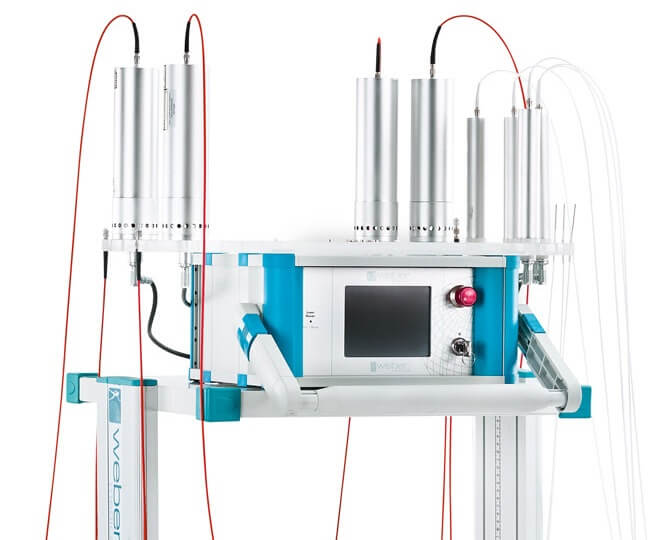
The Weberneedle® Endolaser is a modular low-level laser system designed for photobiomodulation applications in clinical settings.
The Weberneedle Endolaser is one of the few systems that covers the entire electromagnetic spectrum. Also, the wavelengths that are not visible to the human eye, such as ultraviolet and infrared.®
This is a great advantage, especially against the background of the mitochondrial respiratory chain, as the different complexes only react to certain wavelengths.
Blue light, for example, is absorbed by the first electron carrier in the respiratory chain. Light in the red and infrared ranges, on the other hand, in the cytochrome c oxidase complex, the last carrier of the respiratory chain.
Thus, the full cell potential can be exploited.
WeberBrain Pro
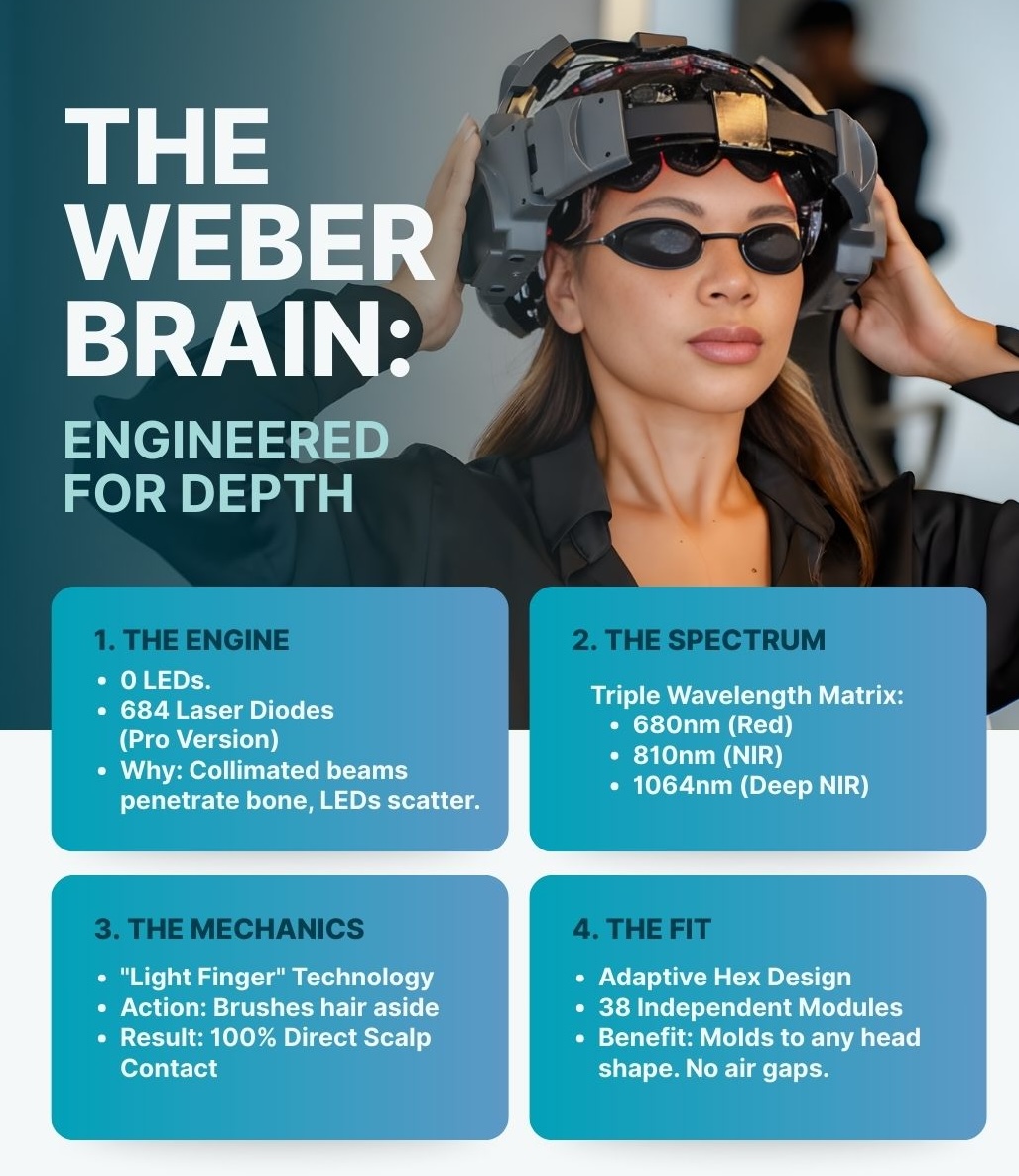
The Weber Brain Pro is designed for transcranial infrared stimulation applications. Multiple studies have explored the potential role of infrared light therapy in supporting neurological function.
Research into transcranial infrared stimulation has investigated its relationship to areas such as mood disorders, brain injuries, neurodegenerative conditions, addiction, and cognitive performance.
Because studies use varying parameters including wavelength, power, session duration, and treatment frequency, standardized protocols are still evolving. However, many research protocols have demonstrated promising results across a variety of neurological investigations.
Scientific Background
Low-level laser therapy (LLLT) uses low-intensity laser light to support the body’s natural regeneration and regulation processes. In contrast to surgical lasers, which specifically destroy tissue, low-level laser therapy does not damage cells.
At the cellular level, certain wavelengths of light increase the formation of adenosine triphosphate (ATP). ATP is known as an energy carrier that accelerates healing and regeneration processes in tissues.
In addition, laser light stimulates the production of stem cells and growth factors and increases the production of nitric oxide (NO) and reactive oxygen species (ROS), among other things. Patients benefit in many ways from improved blood circulation, rapid wound healing, effective pain relief and anti-inflammatory.
Additional Resources
https://webermedical.com/wp-content/uploads/2025/08/250522_weber_medical_broschuere_EN_M.pdf
https://webermedical.com/en/clinic/science/
https://webermedical.com/wp-content/uploads/2025/08/Pain.pdf
https://webermedical.com/wp-content/uploads/2025/08/Acupuncture-Orthopedics.pdf
https://webermedical.com/wp-content/uploads/2025/08/Traumatic-Brain-Injury.pdf
https://webermedical.com/wp-content/uploads/2025/08/Malaria-1.pdf